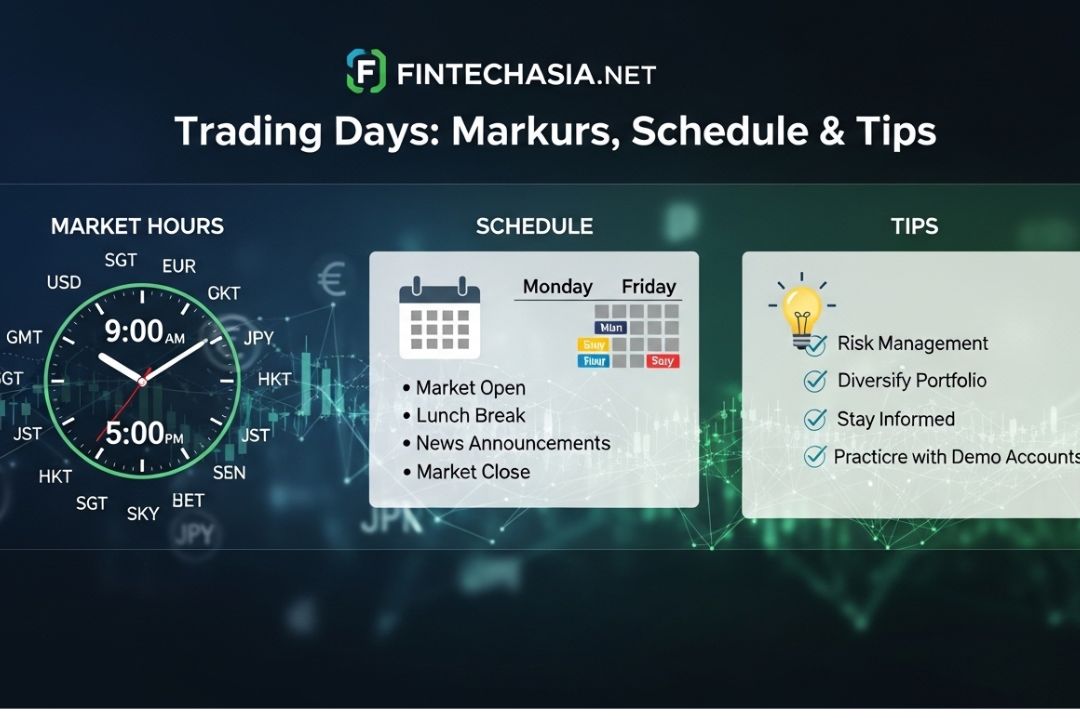
FintechAsia.net Trading Days: Market Hours, Schedule & Tips
The Asian financial markets have become increasingly influential in global trading, and understanding when and how to participate effectively can make the difference between profit and loss. FintechAsia.net Trading Days represent specific periods when Asian markets are most active, offering traders unique opportunities to capitalize on price movements across stocks, forex, cryptocurrencies, and commodities. Whether you’re a seasoned investor or just starting your trading journey, knowing the ins and outs of these trading days will help you make smarter decisions and maximize your returns.
This comprehensive guide will walk you through everything you need to know about FintechAsia.net Trading Days, including market hours, trading strategies, risk management techniques, and how to leverage technology for better results. By the end of this article, you’ll have a clear roadmap for navigating Asian markets with confidence.
Understanding FintechAsia.net Trading Days
FintechAsia.net Trading Days refer to the active trading periods across major Asian financial markets, including Tokyo, Hong Kong, Shanghai, Singapore, and Mumbai. These markets operate during different hours due to varying time zones, creating a continuous flow of trading opportunities throughout the Asian business day.
The concept goes beyond simply knowing when markets open and close. It encompasses understanding market behavior patterns, volume fluctuations, and how global events impact Asian trading sessions. Successful traders recognize that each market has its own personality, influenced by local economic conditions, regulatory environments, and investor sentiment.
Asian markets have grown tremendously over the past two decades. According to recent data, Asian stock markets now represent approximately 35% of global market capitalization, up from just 20% in 2000. This growth has made FintechAsia.net Trading Days increasingly important for anyone serious about global investing.
Major Asian Market Trading Hours
Understanding the specific trading hours for each major Asian market is fundamental to your success. Here’s a breakdown of key markets and their operating schedules:
Tokyo Stock Exchange (TSE)
The Tokyo Stock Exchange operates Monday through Friday with a unique schedule that includes a lunch break. Morning sessions run from 9:00 AM to 11:30 AM JST, while afternoon sessions operate from 12:30 PM to 3:00 PM JST. This totals five hours of active trading daily.
Japanese markets are known for their liquidity and stability, making them attractive for both conservative and aggressive traders. The TSE handles an average daily trading volume exceeding $3 billion, with technology and automotive sectors being particularly active.
Hong Kong Stock Exchange (HKEX)
Hong Kong’s market runs from 9:30 AM to 12:00 PM HKT for the morning session, breaks for lunch, then resumes from 1:00 PM to 4:00 PM HKT. There’s also a pre-opening session starting at 9:00 AM and a closing auction at 4:00 PM.
The HKEX serves as a crucial bridge between mainland China and international investors. With over 2,500 listed companies and an average daily turnover of approximately $15 billion, it’s one of the world’s largest stock exchanges.
Shanghai Stock Exchange (SSE)
Mainland China’s primary exchange operates from 9:30 AM to 11:30 AM CST, breaks for lunch, then continues from 1:00 PM to 3:00 PM CST. The SSE has grown exponentially, now hosting more than 2,000 listed companies with a combined market capitalization exceeding $7 trillion.
Chinese markets can be volatile due to government policy announcements and economic data releases. Traders focusing on FintechAsia.net Trading Days must pay close attention to Chinese regulatory news.
Singapore Exchange (SGX)
Singapore’s market runs continuously from 9:00 AM to 5:00 PM SGT without a lunch break, making it convenient for international traders. The SGX is particularly popular for derivatives trading and serves as a regional hub for commodity futures.
National Stock Exchange of India (NSE)
India’s primary exchange operates from 9:15 AM to 3:30 PM IST. The NSE has become the world’s largest derivatives exchange by number of contracts traded and plays a vital role in Asian market dynamics.
Overlapping Trading Sessions and Opportunities
One of the most profitable aspects of FintechAsia.net Trading Days comes from understanding when different markets overlap. These overlapping periods create increased liquidity and volatility, presenting enhanced trading opportunities.
The Tokyo-Hong Kong overlap occurs from 9:30 AM to 11:30 AM HKT, when both major markets are simultaneously active. This two-hour window often sees significant price movements, especially in currency pairs like USD/JPY and AUD/JPY.
Another critical overlap happens when European markets open while Asian markets are still trading. This period, particularly affecting Hong Kong and Singapore markets, can trigger substantial volatility as news from overnight American sessions gets processed alongside European opening reactions.
Smart traders use these overlapping sessions to their advantage by monitoring multiple markets simultaneously and identifying arbitrage opportunities or correlated movements across different asset classes.
Strategies for Successful Trading During Asian Sessions
Developing effective strategies specifically tailored to FintechAsia.net Trading Days requires understanding the unique characteristics of Asian markets. Here are proven approaches that experienced traders employ:
Momentum Trading
Asian markets often exhibit strong momentum trends, particularly during the first hour of trading. When major economic data is released or significant corporate news breaks, prices can move rapidly in one direction. Momentum traders capitalize on these movements by entering positions early and riding the trend.
A study of Tokyo Stock Exchange data from 2023 showed that stocks moving more than 2% in the first 30 minutes of trading continued in the same direction for the remainder of the session approximately 68% of the time. This statistical edge provides momentum traders with a solid foundation for their strategies.
Range Trading
Some Asian markets, particularly on days without major news events, tend to trade within defined ranges. Hong Kong’s Hang Seng Index, for example, has historically shown range-bound behavior during periods of market consolidation.
Range traders identify support and resistance levels, then buy near support and sell near resistance. This strategy works best during low-volatility periods on FintechAsia.net Trading Days when markets are waiting for catalysts.
News-Based Trading
Economic announcements from China, Japan, and other Asian economies can trigger significant market movements. Traders who position themselves ahead of major releases like Chinese GDP figures, Japanese Tankan surveys, or Reserve Bank of Australia interest rate decisions can profit from the resulting volatility.
The key is understanding not just what the data says, but how it compares to market expectations. A Chinese retail sales figure that exceeds forecasts by 1% might trigger a rally across Asian equities and strengthen the yuan.
Technology and Tools for Trading Asian Markets
Modern technology has revolutionized how traders approach FintechAsia.net Trading Days. Several technological tools have become essential for serious market participants:
Advanced Trading Platforms
Platforms like MetaTrader 5, TradingView, and Bloomberg Terminal provide real-time data feeds from Asian exchanges, advanced charting capabilities, and automated trading functions. These platforms allow traders to monitor multiple markets simultaneously and execute trades with minimal latency.
Many platforms now offer mobile applications, enabling traders to stay connected to Asian markets regardless of their physical location. This mobility is particularly valuable given the time zone differences between Asia and Western markets.
Algorithmic Trading Systems
Algorithmic trading has become increasingly prevalent in Asian markets. Estimates suggest that algorithmic trades now account for over 40% of trading volume on major Asian exchanges, up from less than 20% a decade ago.
These systems can identify patterns, execute trades at optimal prices, and manage risk more efficiently than manual trading. However, they require significant technical expertise and ongoing monitoring to ensure they adapt to changing market conditions.
Market Scanners and Screeners
Real-time market scanners help traders identify opportunities across hundreds or thousands of securities during FintechAsia.net Trading Days. These tools can filter stocks based on price movements, volume spikes, technical indicators, or fundamental criteria.
For example, a trader might set up a scanner to alert them whenever a stock on the Hong Kong exchange experiences a volume spike of 200% above its 30-day average while also breaking above a key resistance level.
Risk Management During Asian Trading Sessions
Effective risk management is absolutely critical when participating in FintechAsia.net Trading Days. Asian markets can be particularly volatile due to lower liquidity compared to U.S. markets and sensitivity to regional geopolitical events.
Position Sizing
Never risk more than 1-2% of your trading capital on any single trade. This conservative approach ensures that even a series of losses won’t devastate your account. With Asian markets sometimes exhibiting gaps and rapid price movements, disciplined position sizing becomes even more important.
Stop-Loss Orders
Always use stop-loss orders to limit potential losses. However, be aware that during periods of extreme volatility, stop-loss orders might not execute at your intended price due to slippage. Consider using guaranteed stop-loss orders when available, though these typically come with a premium cost.
Currency Risk
For traders outside Asia, currency fluctuations add another layer of risk. The value of your profits or losses will be affected by exchange rate movements between your home currency and the currency of the market you’re trading. Some traders hedge this currency risk using forex positions, while others accept it as part of their overall risk profile.
Diversification
Don’t concentrate all your trading activity in one market or sector. Spread your positions across different Asian markets, asset classes, and industries. When the Japanese technology sector experiences a downturn, Indian pharmaceuticals might be rallying, providing balance to your overall portfolio.
Economic Indicators That Impact Asian Markets
Understanding the economic indicators that move Asian markets is essential for anyone serious about FintechAsia.net Trading Days. Here are the most influential data releases:
Chinese Economic Data
China’s economic reports have outsized influence across all Asian markets. Key releases include GDP growth rates, Purchasing Managers’ Index (PMI) figures, retail sales, industrial production, and trade balance data.
When China’s PMI comes in below the critical 50 level, indicating economic contraction, ripple effects are felt across commodity markets, neighboring Asian economies, and companies dependent on Chinese demand. A real-world example occurred in August 2023 when disappointing Chinese economic data triggered selloffs across Asian equity markets, with Hong Kong’s Hang Seng Index falling 3.2% in a single session.
Japanese Central Bank Decisions
The Bank of Japan’s monetary policy decisions significantly impact not only Japanese markets but also global currency markets. Any hints of policy shifts, particularly regarding their long-standing ultra-loose monetary policy, can trigger substantial yen movements and affect Japanese export companies’ competitiveness.
Regional Trade Data
Export and import figures from major Asian economies provide insights into economic health and trade dynamics. Singapore’s non-oil domestic exports, South Korea’s semiconductor shipments, and Taiwan’s export orders all serve as bellwethers for regional economic trends.
Seasonal Patterns in Asian Trading
FintechAsia.net Trading Days exhibit certain seasonal patterns that informed traders can exploit. Understanding these cyclical behaviors adds another dimension to your trading strategy.
Year-End and New Year Effects
Many Asian markets experience the “January Effect,” where stocks tend to rally in the first month of the year. This phenomenon is attributed to year-end tax selling creating bargains, new capital allocation at the start of fiscal years, and general optimism.
Japanese markets have particularly strong seasonal patterns around their fiscal year-end in March, when companies engage in window dressing and investors rebalance portfolios.
Cultural Events and Holidays
The Lunar New Year significantly impacts trading across Chinese, Hong Kong, Taiwanese, Singapore, and Vietnamese markets. Trading volumes typically decline in the weeks leading up to the celebration as investors square positions, then surge afterward as new money enters markets.
Similarly, India’s Diwali festival is traditionally considered an auspicious time for new investments, often leading to increased market activity and positive sentiment in late October or early November.
Monsoon Season Impact
In India, monsoon rainfall directly affects agricultural output, rural income, and consumer spending. Strong monsoon seasons typically correlate with improved performance in consumer goods, automotive, and rural-focused sectors, while weak monsoons have the opposite effect.
Common Mistakes to Avoid
Even experienced traders make mistakes when approaching FintechAsia.net Trading Days. Here are pitfalls to avoid:
Ignoring Time Zone Differences
Failing to account for time zone differences leads to missed opportunities or unexpected overnight positions. Set clear trading schedules that align with your target markets’ active hours, and use alerts to notify you of market openings if you’re trading from a different time zone.
Underestimating Political Risk
Asian markets can be significantly affected by political developments, from elections to policy changes to geopolitical tensions. The 2023 tensions in the Taiwan Strait caused immediate volatility across Taiwanese stocks and the broader region. Stay informed about political developments that might impact your positions.
Overleveraging
The availability of high leverage in forex and derivative markets tempts traders to take oversized positions. While leverage can amplify profits, it equally magnifies losses. Many professional traders use far less leverage than available, preserving capital for long-term success.
Chasing Headlines Without Context
News moves markets, but not all news is equally significant. Traders who reactively chase every headline without understanding the broader context often enter trades at the worst possible prices. Develop a framework for evaluating news relevance before acting.
Building a Trading Plan for Asian Markets
Success in FintechAsia.net Trading Days requires a comprehensive trading plan that addresses your goals, strategies, risk parameters, and evaluation metrics.
Your plan should specify which markets you’ll focus on, what trading style suits your schedule and temperament, how much capital you’ll allocate, and what returns you’re targeting. It should include detailed entry and exit criteria, position sizing rules, and maximum daily or weekly loss limits.
Equally important is your plan for continuous improvement. Maintain a trading journal documenting every trade, including your reasoning, emotions, and outcomes. Regular review of this journal reveals patterns in your decision-making, both positive and negative, allowing you to refine your approach over time.
Successful traders treat their trading plan as a living document, updating it as they gain experience and as market conditions evolve. However, they avoid making changes impulsively after a few bad trades, instead requiring statistically significant data before modifying proven strategies.
The Future of Asian Trading Markets
Asian markets continue evolving rapidly, driven by technological innovation, regulatory changes, and shifting economic power. Understanding these trends helps traders position themselves for future opportunities during FintechAsia.net Trading Days.
The digitalization of Asian finance is accelerating, with digital payment systems, blockchain-based settlement, and artificial intelligence analytics becoming mainstream. China’s push toward a digital yuan, Singapore’s embrace of fintech innovation, and India’s Unified Payments Interface demonstrate how technology is reshaping Asian financial infrastructure.
Environmental, Social, and Governance (ESG) investing is gaining momentum across Asia. Hong Kong, Singapore, and Tokyo exchanges have all introduced sustainability reporting requirements and green bond listings, reflecting growing investor demand for responsible investments.
The continuing rise of retail investor participation, enabled by mobile trading apps and fractional share ownership, is democratizing access to markets across Asia. This trend brings both increased liquidity and potential for sentiment-driven volatility.
Conclusion
Mastering FintechAsia.net Trading Days opens doors to some of the world’s most dynamic and rapidly growing financial markets. The key to success lies in thorough preparation, disciplined execution, and continuous learning.
Start by deeply understanding the trading hours, characteristics, and influential factors for each major Asian market. Develop strategies tailored to the specific opportunities these markets present, whether that’s momentum trading during volatile opening sessions or range trading during consolidation periods.
Implement robust risk management that protects your capital through position sizing, stop-losses, and diversification. Stay informed about economic indicators and political developments that move markets, and leverage technology to enhance your analysis and execution.
Remember that consistent profitability in trading is a marathon, not a sprint. Build your expertise gradually, learn from both successes and failures, and maintain the discipline to follow your trading plan even when emotions run high.
The Asian markets represented by FintechAsia.net Trading Days will continue growing in global importance. By developing your skills and knowledge now, you’re positioning yourself to capitalize on opportunities for years to come.
Ready to begin your Asian trading journey? Start by opening a demo account with a broker offering access to Asian markets, practice with virtual money until you’ve proven consistent profitability, then transition to live trading with conservative position sizes. Your future trading success starts with the decisions you make today.